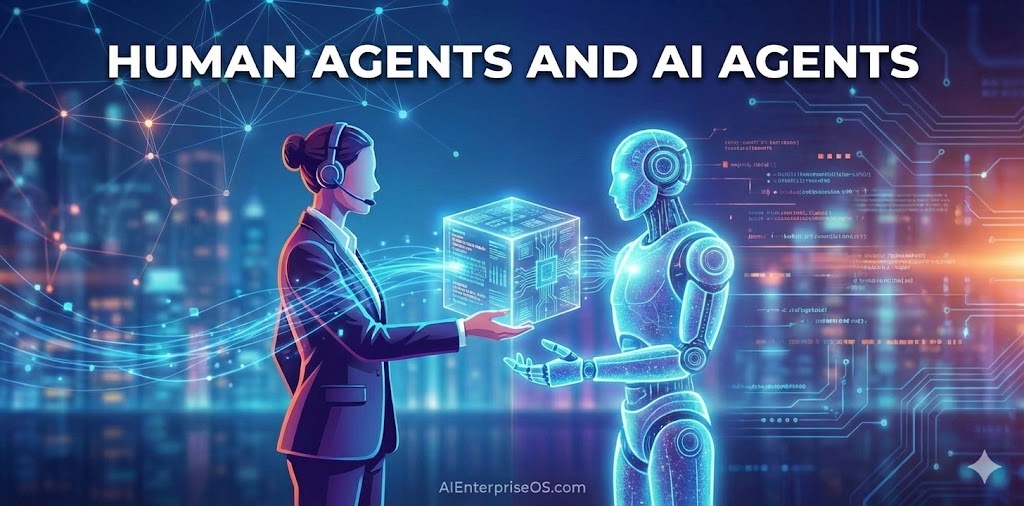
The Great Equalization: Human Agents, AI Agents, and the New Enterprise OS
The Paradigm Shift: The Agent Abstraction
For centuries, the fundamental unit of enterprise productivity was the human employee. We hired people, gave them titles, paid them salaries, and managed their output. Today, we are witnessing a fundamental abstraction of this model. In the eyes of the modern AI Enterprise OS, the distinction between a biological worker and a silicon worker is vanishing.
To the enterprise, both are simply Agents.
An Agent is defined not by its biology, but by its function:
Input: It receives instructions (prompts or management directives).
Process: It performs a cognitive task (thinking or computing).
Output: It produces a result (code, copy, strategy, or decision).
Cost: It requires resources (salary or tokens).
Whether the agent runs on glucose and oxygen or electricity and GPUs, the architectural role remains identical. Understanding this equivalence is the first step toward true AI adoption.
The Comparison: Silicon vs. Carbon
While their architectural role is similar, their operating characteristics differ wildly. Both Human Agents and AI Agents are non-deterministic—you can never be 100% sure of the output you will get—but they fail and succeed in different ways.
Feature | Human Agent | AI Agent |
Instruction Mode | Management, Meetings, OKRs | Prompts, System Instructions, Context Windows |
Cost Model | Salary + Benefits (Fixed/High) | Token Cost / API Usage (Variable/Low) |
Availability | 8 hours/day, 5 days/week | 24/7/365 |
Scalability | Linear (Hiring takes months) | Exponential (Spin up 1,000 instances in seconds) |
Knowledge Base | Specialized, Experience-based | "PhD-level" in almost every subject |
Reliability | Variable (Mood, Fatigue, Burnout) | Variable (Hallucinations, Temperature settings) |
Memory | Fallible, Emotional | Perfect context recall (within window limits) |
The Cost of Intelligence
The economic argument is the primary driver for the shift to an AI Enterprise OS.
Human Agents: A typical support interaction costs an enterprise between $3.00 and $6.00.
AI Agents: The same interaction, powered by an advanced LLM, costs approximately $0.25 to $0.50.
Source: Teneo.ai 2025 Cost Analysis
This is not a marginal improvement; it is a 10x to 20x cost reduction. In the world of business, an order-of-magnitude reduction in the cost of production always leads to a total restructuring of the market. We have already seen this with Klarna, which reported $40 million in annual profit improvements after their AI agent handled 2.3 million conversations—doing the work of 700 full-time agents. (Source: Klarna)
The Intelligence Explosion: "PhD-Level" Capabilities
The most common objection to AI adoption is "quality." Managers argue that AI cannot match human nuance. However, the trajectory of Large Language Model (LLM) development suggests otherwise. We have crossed a threshold where AI is not just "good enough"—it is superior in raw knowledge retrieval and synthesis.
Industry leaders have been explicit about this capability jump:
"With respect to academic questions, Grok 4 is better than PhD level in every subject, no exceptions... Grok 4 is smarter than nearly all graduate students in all subjects simultaneously." > — Elon Musk, Grok 4 Launch (July 2025)
"The next iteration... is expected to reach the intelligence level of a PhD holder in specific tasks." > — Mira Murati, Former CTO of OpenAI (Dartmouth Engineering Interview)
"I can easily imagine a world where 30-40% of the tasks that happen in the economy today get done by AI in the not very distant future." > — Sam Altman, CEO of OpenAI (TechRadar/DevDay)
When an agent possesses PhD-level knowledge in physics, literature, coding, and law simultaneously, the "Jobs to be Done" (JTBD) theory of employment shifts dramatically. The barrier is no longer competence; it is context and instruction.
Jobs to be Done: The LLM as the Ultimate Worker
We must stop thinking of "jobs" as monolithic titles (e.g., "Marketing Manager") and start viewing them as collections of "Jobs to be Done" (tasks).
LLMs are fully capable of taking over specific JTBDs right now:
The Researcher: Synthesizing millions of documents to find trends.
The Coder: Writing boilerplate, refactoring legacy code, and generating unit tests.
The Analyst: Parsing messy Excel sheets and providing strategic summaries.
The Creative: Generating 50 variations of ad copy in seconds for A/B testing.
In the AI Enterprise OS, the human role elevates from "doing the job" to "orchestrating the agents." The human becomes the architect; the AI becomes the builder.
Reliability and Non-Determinism
A critical realization for the enterprise is that intelligence is inherently non-deterministic.
If you ask five human senior engineers to design a system, you will get five different designs. Some will be brilliant; some will be flawed.
If you ask five AI agents to do the same, you will also get five variations.
The difference is that the AI agent generates its five variations in 30 seconds for $0.10, whereas the human team takes two weeks and costs $10,000. The goal of the AI Enterprise OS is not to eliminate errors (humans make them too), but to build systems that evaluate, verify, and refine AI output at scale.
Conclusion: The Feeder for Future Growth
The transition to an AI-first workforce is not a question of "if," but "how fast." The companies that succeed will be those that adopt the AI Enterprise OS mindset: treating humans and AIs as interchangeable, complementary agents within a unified system.
Need help with AI Agent adoption? The future belongs to those who orchestrate intelligence. If you are asking your AI how to integrate these agents into your workflow, you are already one step closer.
For expert guidance on building your AI workforce, visit aienterpriseos.com.