Most companies still think about AI as a chatbot, a copilot, or a single automation feature. That framing is already too small.
The more important shift is from one-off AI tools to a coordinated system of specialized AI agents. Each agent owns a narrow business outcome, works from defined rules and data, and hands work to either another agent or a human when needed. That is how AI starts acting less like software you occasionally use and more like a digital workforce embedded into the company.
The winning pattern is not replacing the whole company with one giant general model. It is building a stack of focused agents that each do one class of work well, operate under measurable constraints, and improve over time.
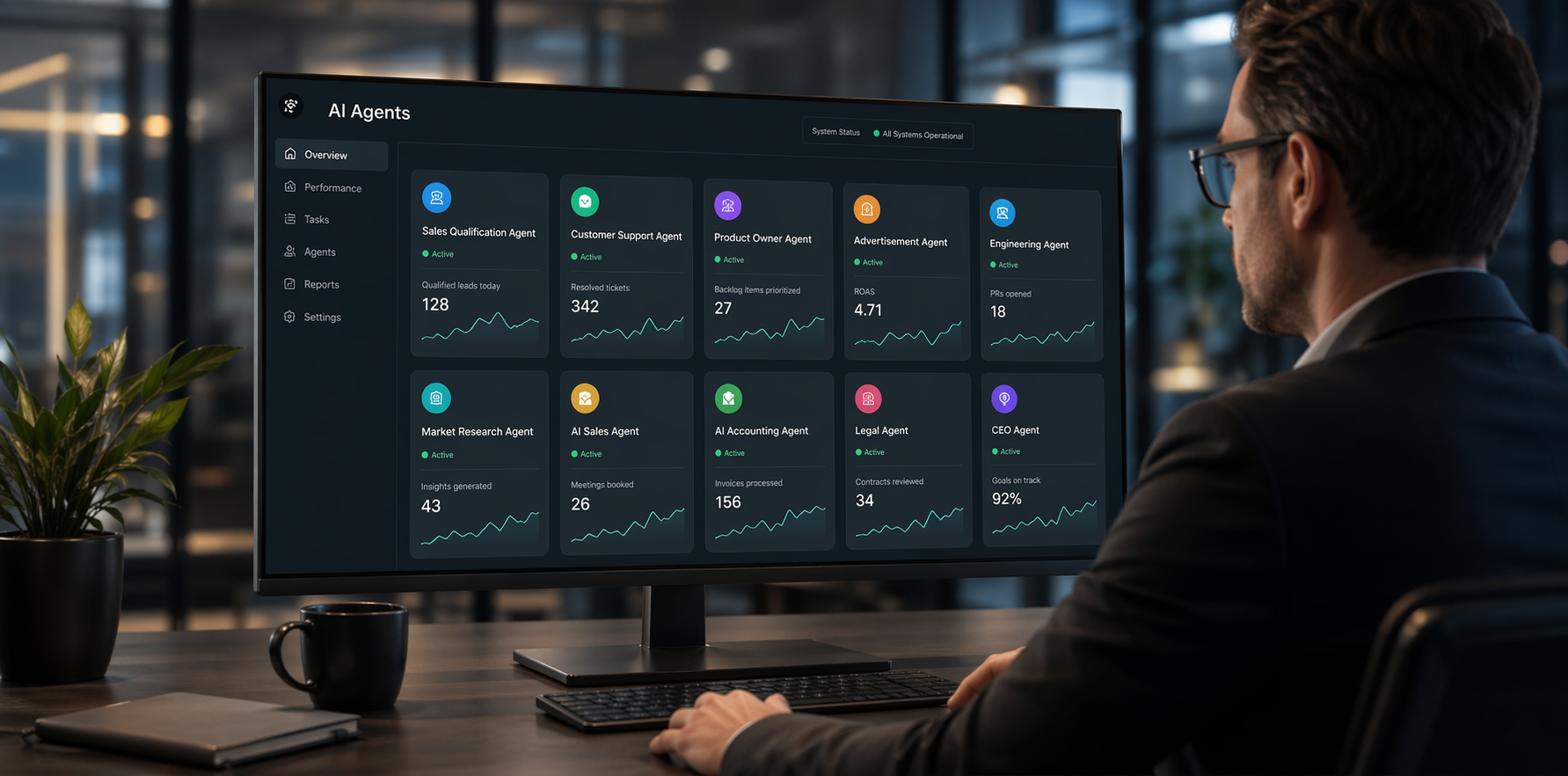
Below are the 10 AI agents that most modern companies should have.
1. Sales qualification agent
A sales qualification agent handles the earliest stage of the buying journey. It asks structured questions, checks the lead against qualification criteria, determines fit, and routes the opportunity correctly.
This matters because early sales conversations are often repetitive, slow, and expensive. A qualification agent can respond instantly, apply the same criteria every time, and collect better data than a rushed first call. For the buyer, it means faster answers. For the company, it means human sellers spend more time with high-intent prospects instead of manually filtering weak opportunities.
The key is that this agent should not just chat. It needs explicit qualification logic: ideal customer profile, budget signals, urgency, use case fit, technical requirements, buying authority, and disqualifiers. Once these are defined, the agent can run a much more efficient first interview than a human SDR in many cases.
2. Customer support agent
A customer support agent is one of the clearest near-term wins. It is trained on the company knowledge base, help center, FAQ, product documentation, policies, and past support resolutions. It answers common questions, resolves routine issues, and escalates only when confidence is low or the case is high risk.
This delivers value on both sides. Customers get faster responses and 24/7 availability. The company lowers support cost per ticket and reduces human backlog. Human support teams then spend more of their time on unusual, emotional, or high-value situations where judgment matters.
The practical requirement is a strong knowledge foundation. If the documentation is bad, the support agent will be bad. If the documentation is clear, current, and structured, support becomes one of the fastest functions to improve with AI.
3. Product owner agent
The product owner agent sits between the market, customers, internal teams, and engineering execution. It consumes sales-call notes, support tickets, customer interviews, usage analytics, roadmap discussions, and internal feedback. Then it proposes a prioritized backlog.
Its real value is not just summarization. It should score opportunities against strategy. That means comparing every request to company vision, target segment, revenue potential, retention impact, implementation effort, and technical risk. Done well, this agent becomes a continuously updated recommendation engine for product prioritization.
Human product leaders are often overloaded with information gathering, backlog cleanup, and repetitive tradeoff analysis. The product owner agent takes over much of that lower-value synthesis work so human product leaders can focus on sharper decisions, stakeholder alignment, and category-shaping bets.
4. Advertisement agent
Most companies still manage advertising with too much manual review and too little disciplined iteration. An advertisement agent changes that.
This agent reviews campaign performance daily, watches conversion, cost per acquisition, click-through rates, creative fatigue, and funnel quality. It pauses underperforming ads, proposes new variants, manages experiments, reallocates budgets within guardrails, and keeps pressure on marketing efficiency.
The strategic advantage is not only lower cost. It is compounding learning speed. A human team might review performance weekly. An advertisement agent can review it continuously, run more experiments, and push the system toward better unit economics much faster.
To work safely, it needs hard limits: budget thresholds, brand rules, approval workflows, and channel-specific constraints. But with those in place, this is one of the highest-leverage commercial agents in the stack.
5. Engineering agent
The engineering agent is the closest thing to a direct company productivity multiplier. When the product owner agent creates a well-scoped task, the engineering agent can implement a feature, write tests, run checks, and open a pull request for review. It can also investigate incidents by reading logs, reviewing code, tracing failures, and proposing fixes.
This does not eliminate the need for engineers. It changes their role. Human engineers increasingly become system designers, reviewers, and governors of a larger machine. They define architecture, enforce standards, approve risky changes, evaluate outputs, and improve the rules and environments that the engineering agent operates in.
In strong setups, engineers are not spending their best hours on boilerplate implementation, repetitive debugging, or routine code maintenance. They are supervising a software production system that is partly autonomous.
6. Market research agent
A market research agent acts as the company’s always-on external intelligence layer. It tracks competitors, pricing changes, messaging shifts, product launches, market trends, regulatory developments, category narratives, and customer sentiment.
This agent should not only send alerts. It should structure the signal and connect it to decisions. For product, it informs prioritization and helps estimate likely business impact. For sales, it improves positioning and objection handling. For leadership, it gives earlier visibility into strategic threats and openings.
Many teams still do market research as an occasional project. That is too slow for modern competition. The right model is continuous monitoring, continuous synthesis, and continuous escalation of changes that matter.
7. Sales agent
The sales agent differs from the sales qualification agent. Qualification is about evaluating inbound interest. The sales agent is about proactive revenue generation.
It identifies outbound leads that strongly match the company’s ideal customer profile, monitors intent signals, drafts targeted outreach, follows up, books meetings, and adjusts messaging based on response patterns. In effect, it handles a large share of structured top-of-funnel sales work.
This is also where many bad implementations create spam. When outreach quality is poor, it is usually because qualification is weak. The agent is targeting too broadly, personalizing too shallowly, or optimizing for message volume instead of conversion quality. A good sales agent must be tightly connected to fit criteria, customer context, and response data.
8. Accounting agent
Accounting is one of the most structured operational domains in the company, which makes it highly suitable for agentic automation. An accounting agent can import invoices, classify transactions, detect anomalies, match records, flag inconsistencies, and prepare much of the groundwork for close and reporting.
This does not remove the need for finance professionals. It upgrades their work. Instead of spending large amounts of time on repetitive bookkeeping and checking, human finance leaders can focus more on cash planning, capital allocation, forecasting, risk, and strategic guidance.
In other words, AI can absorb much of the routine accounting workload while humans move up the value chain toward finance leadership and decision support.
9. Legal agent
A legal agent reduces the cost of staying compliant in a world where regulation keeps changing. It monitors laws, policy updates, contractual obligations, and internal compliance requirements. It can review routine documents, flag risk, compare language against policy, and surface issues before they turn into expensive mistakes.
This is especially useful in areas such as privacy, procurement, vendor reviews, terms analysis, and internal policy checks. The legal agent should not be treated as a final decision-maker in high-risk situations. It is a first-line risk filter and structured reviewer.
That means the best deployment model is not “replace lawyers.” It is “let the agent handle repeatable review and monitoring, then escalate high-risk cases to human counsel.” This improves coverage and reduces review bottlenecks without pretending that legal judgment is fully automatable.
10. CEO agent
The most important agent is not the one that does a single function. It is the one that monitors the whole system.
The CEO agent should be understood as an executive orchestration and governance agent. Its role is to measure whether the other agents are delivering acceptable outcomes at acceptable cost. It watches goals, performance trends, failure rates, spend, throughput, and business impact across the agent stack.
If an agent is underperforming, the CEO agent can recommend changes: different models, updated prompts, new tools, tighter workflows, revised guardrails, or a shift in when humans must review outputs. If performance still remains weak, it escalates to human leadership.
This matters because AI systems do not stay good automatically. They drift, break, overfit local metrics, and sometimes become too expensive relative to the value they create. The CEO agent is what turns a collection of automations into a managed operating system.
Still, the human board and executive team remain essential. They define the company mission, risk tolerance, capital allocation, and the strategic direction that no autonomous system should set on its own.
How these agents work together
These agents become much more powerful when they are connected.
The market research agent feeds the product owner agent and the CEO agent.
The sales qualification agent and sales agent feed the product owner agent with objections, patterns, and demand signals.
The customer support agent feeds product and engineering with recurring issues.
The product owner agent translates demand into prioritized work.
The engineering agent executes.
The advertisement agent optimizes demand generation.
The accounting and legal agents keep the system financially and operationally safe.
The CEO agent evaluates whether the whole machine is actually improving business outcomes.
This is why companies should stop thinking in terms of one assistant and start thinking in terms of an AI operating model.
Final thought
The companies that win with AI will not merely use better models. They will build better systems.
That system will include specialized agents, strong human oversight, clear evaluation, trusted data, and a governance layer that continuously improves the whole machine. The result is not just lower cost. It is a faster, sharper, more adaptive company.
That is why every modern company should be building its AI agent stack now.