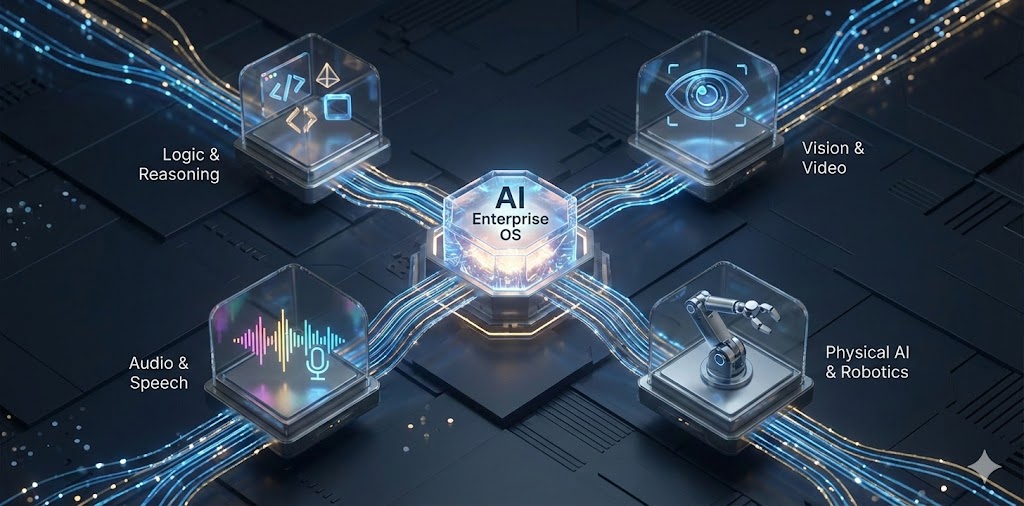
The Brain is a Team, Not a Monolith: Why Specialized AI Models Are the Future of Enterprise
For years, the "holy grail" of artificial intelligence was often depicted as a single, all-knowing super-brain—a monolithic General Artificial Intelligence (AGI) that could write poetry, drive a car, and diagnose a rare disease with the same set of neurons. But as we move deeper into 2026, the industry is waking up to a biological reality: true intelligence isn't a monolith; it’s a mixture of experts.
The human brain, the most efficient learning machine we know, is not one solid computational unit. It is a highly modular system where distinct regions control vision, speech, motor control, and reasoning. When you catch a ball, your visual cortex tracks the object, your motor cortex coordinates your hand, and your prefrontal cortex predicts the trajectory. They are specialized agents working in concert.
Today, the most advanced AI architectures are evolving to mirror this biological truth. We are moving away from "jack-of-all-trades" models toward an ecosystem of specially finetuned experts.
The Rise of the "Mixture of Experts" (MoE)
The technical term for this shift is the Mixture of Experts (MoE) architecture. Instead of activating a massive, trillion-parameter model for every simple query, an MoE system routes a request to a small set of "expert" sub-networks best suited for the task.
Recent research supports this "brain-like" modularity. A 2025 study titled "Mixture of Cognitive Reasoners" demonstrated that partitioning AI layers into specialized modules—aligned with human cognitive networks like language and logic—resulted in systems that were not only more interpretable but outperformed massive generalist baselines on complex reasoning tasks.
For the enterprise, this means efficiency. Why burn the energy required to simulate Shakespeare just to categorize a receipt? Specialized agents are faster, cheaper to run, and far more accurate in their specific domains.
The Landscape of Specialized Experts: 2026 Edition
Just as the brain has regions for sight, sound, and movement, the open-source and enterprise AI landscape has fragmented into powerful, domain-specific models.
1. The Language & Logic Experts (Text)
While generalist LLMs started the revolution, 2025 saw the dominance of efficient, open-source text specialists.
DeepSeek R1 & LLaMA 3: These models have redefined the open-source landscape, offering enterprise-grade reasoning and coding capabilities that rival proprietary "frontier" models.
Mixtral 8x22B: A prime example of the MoE architecture in action, this model activates only a fraction of its parameters per token, allowing for high-speed inference without sacrificing the "smarts" needed for complex business logic.
2. The Visual Cortex (Vision & Video)
Video generation and analysis have moved beyond simple novelties to become robust enterprise tools.
Mochi & Hunyuan: Released in late 2024 and maintained through 2025, these became standards for open-source video generation, allowing developers to fine-tune models for specific marketing or training video styles.
NVIDIA Cosmos: A physical AI platform designed to help robots and agents "understand" the world, bridging the gap between pixel generation and physical physics.
3. The Auditory Centers (Speech & Audio)
The "voice" of AI has become indistisnguishable from human speech, thanks to models that specialize solely in audio waveforms.
VibeVoice (Microsoft): A breakthrough from early 2026, this model specializes in long-form, multi-speaker generation, maintaining consistent voice identities over 90-minute sessions—perfect for automated audiobooks or podcast generation.
Kokoro-82M: A lightweight, open-source text-to-speech model that proves size isn't everything. It runs efficiently on edge devices, enabling real-time voice agents without the latency of cloud-based giants.
4. The Motor Cortex (Robotics & Physical AI)
Perhaps the most exciting frontier is "Physical AI"—models that don't just think, but act.
NVIDIA GR00T: An open foundation model specifically for humanoid robots. It doesn't write poems; it learns how to walk, grasp objects, and navigate warehouses.
Alpamayo: Released in January 2026, this family of open models is designed for autonomous vehicles. It focuses on the life-or-death logic required for self-driving, a domain where a hallucinating chatbot would be catastrophic.
The Implementation Gap: Build vs. Buy
While the potential of a specialized "team of experts" is vast, the barrier to entry is equally high. Selecting the right model for the right task and wrapping it in a functional agent framework is a deeply complex engineering challenge.
For an enterprise to manage this transition internally, it requires a massive investment in specialized talent—data scientists, prompt engineers, and AI architects—who understand the nuances of quantization, fine-tuning, and low-latency orchestration. Building this know-how from scratch is often a multi-year journey that distracts from core business objectives.
Because this landscape shifts monthly, most enterprises find it far more efficient and cost-effective to contract with expert solution providers. Partnering with specialists who already possess the infrastructure and battle-tested "agentic" frameworks allows businesses to deploy specialized AI in weeks rather than years, turning a complex technical hurdle into a turnkey competitive advantage.
The Future: An Operating System of Agents
The lesson for the enterprise is clear: Don't look for one model to rule them all. Look for an orchestration layer—an "operating system"—that can manage this team of specialists.
Just as your brain seamlessly coordinates your eyes and hands, the AI Enterprise OS of the future will effectively be a router. It will take a user's intent, dispatch the visual elements to a video model, the logic to a reasoning agent, and the execution to a robotic process, synthesizing the results into a single, cohesive solution.
The era of the monolithic model is ending. The era of the specialist team has begun.